How to Read a Neighborhood's History Through Its Alley Doorways
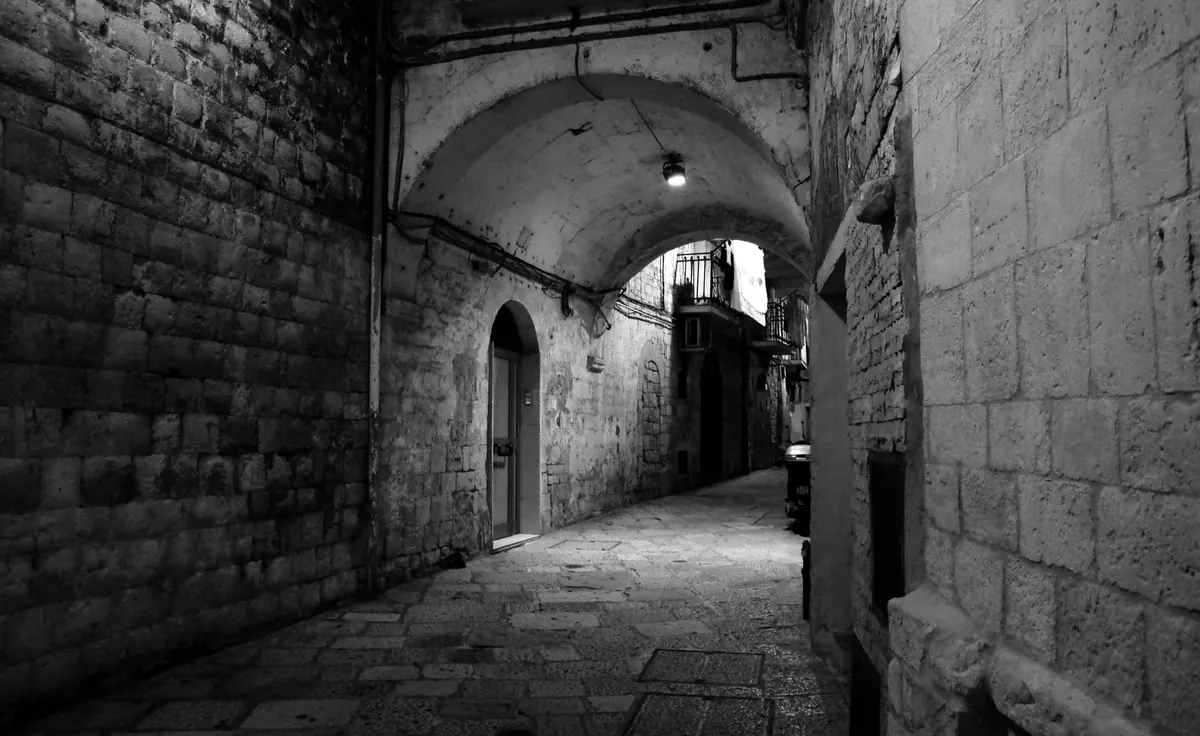
Alley doorways are not just entrances. They are the most legible part of a street's archive: a worn step, a patched jamb, a date carved above the lintel. You do not need permission to read them, only patience and the habit of looking twice. The clues are small, but they add up. Start with the ground and work upward.
Before you look at the door, look at what meets the street. Thresholds take more traffic than any other part of a building, and they record it. A stone step hollowed in the middle has been worn by feet over a long period. A step replaced with a single slab of newer stone may mark a repair after settlement, flooding, or a change in street level. In a damp alley, a high threshold is often a practical answer to water, not a grand gesture.
Check the material under your feet. Old stone, brick, cobbles, concrete, and tile all behave differently. A strip of concrete between an old stone threshold and the pavement is a later intervention, and a useful one to note. So is a step that is wider than the door: it may once have served a shop, a workshop, or a passage that has since been closed.
Look at wear patterns, too. A hollow in the centre suggests years of straight-on use. Wear concentrated at one side can hint at a former counter, a cart route, or a doorway that once opened differently. These are not proofs. They are questions the building is asking you to ask.
Work up the jambs and around the opening. The door leaf is the easiest part to replace, so the frame often tells you more. Stone jambs, brick surrounds, timber posts, and plastered reveals each suggest different materials, budgets, and building phases. Compare three doorways on the same side of the alley. If one has a deep reveal and another almost none, you are probably looking at different wall thicknesses, different functions, or different periods.
The lintel is the most talkative element. A flat stone lintel, a shallow brick arch, a timber beam, or an iron bar all solve the same problem—carrying weight above an opening—in different ways. Look at how the surrounding wall meets the lintel. A neat joint may be original; a rough patch of brick or cement may be a repair.
Mortar deserves a close look. Traditional lime mortar is usually softer and more permeable than modern cement mortar, and a ribbon of hard grey cement between old bricks is a visible sign of a later repair. Do not treat it as a scandal. Treat it as a dateable layer in the doorway's life. The same goes for a transom or fanlight above the door: it may have been added to bring light into a dark passage, or it may be the only surviving part of an earlier opening.
Look above eye level and at the edges. Dates are often carved into lintels, keystones, or small plaques. Initials, family names, and simple symbols appear too. A date may mark construction, but it can also commemorate a renovation, a marriage, a change of ownership, or a business. Read it as a claim made at a particular moment, not as a birth certificate for the whole building.
House numbers are another layer. Painted numbers, enamel plates, carved numerals, and modern stickers can all coexist on the same street. A number that breaks the sequence may point to renumbering, a former entrance, or a building that was once divided. Numerals themselves can offer hints—an open-topped four, a seven with a crossbar, a one with a long serif—but treat style as a hint, not a verdict.
And remember the simplest caution: the date on a door is rarely the date of the building. Doors are replaced, moved, reused, and rebuilt. The frame usually remembers more than the leaf.
A doorway is a biography of maintenance. A patch of brick where a bell was removed, a filled keyhole, a slice of newer stone in a worn step, a replaced panel in an old door—these are the sentences of that biography. Paint layers help. Thick ridges, alligator cracks, and different colours at the edges show repeated attention. New screws in old hinges are a small but honest clue.
The most useful question is not “Is this original?” but “What happened here, and in what order?” A doorway that has been widened, narrowed, raised, or partly blocked will usually show seams where old work meets new. Learn to enjoy those seams. They are often more revealing than a perfectly restored façade.
Handles, keyholes, bells, mail slots, boot scrapers, lamp brackets, and hooks tell you how a doorway was used. Worn paint around a handle shows where hands landed. A low or off-centre keyhole may reflect an old lock, a child's reach, or a later replacement. A bell pull beside the door, a small speaking grille, or a slot for letters suggests a particular relationship between the street and the rooms behind it.
A wide, plain door with heavy hinges may have served a courtyard, a workshop, or a stable. A door with a small hatch or a former shop window may have been a counter before it was a home entrance. These are possibilities, not certainties. Use them to sharpen your eye, then look for corroboration in the wall above, the step below, and the neighbours on either side.
Pick a short stretch—twenty doorways is plenty—and walk it twice. The first pass is for impressions; the second is for evidence.
Do this at different times of day if you can. Morning light flatters stone; late afternoon light exposes texture. If a doorway is clearly private, admire it from the street and do not test handles or gates. A notebook and a camera are enough.
Old doorways reward humility. You will not date a building from a hinge, and you should not try. But you can learn to see sequence: old stone, newer patch, replaced door, fresh number. That is local history at walking pace. Carry a small notebook, note the street and the time, and return to the same doorways after a few weeks. Patterns emerge—not grand conclusions, but a sharper sense of how a neighbourhood has been repaired, adapted, and lived in. The alley stops being a corridor between places and becomes a place with its own stories.
Photo: Pille Kirsi / Pexels